
Originally introduced in 1975,the Monk class has been subject to various revisions throughout Dungeons & Dragons’ history, culminating in their current form in 5e, always with a bent toward martial arts and unarmed fighting. As a Chinese-American, that bothers me a lot. Like an offensive “jelly donut,” the Monk appears enticing, but is filled to bursting with Orientalist imagery and stereotypes. I have a hard time even being mad at it – like Avatar the Last Airbender, the class was clearly made with love in mind rather than hate.

The imagery of the martial artist Monk is directly tied to the Shaolin Temple (少林寺; shàolínsì), which serves as the general image of Far Eastern religion for most Westerners looking through an Orientalist lens. Kung fu has been practiced at this temple as far back as historic record goes, and the modern Shaolin Temple aesthetic still informs the West’s vision of martial arts and Eastern religion. However, by definition a Monk is a lot closer to a Cleric. In <em>The Evolution of Fantasy Role-Playing Games</em> (2014), Michael Tresca says the class “is one of the few classes that have no anchor in Western lore […] one set of lead miniatures had Franciscan-style monks posed in martial arts stances.” While I would love to see more of that exact thing, there is no denying a deeply Orientalist bent to the entire class, which is reductive on both an aesthetic and gameplay level.
The Clerics, meanwhile, have shouldered the burden of Monks’ spiritual responsibilities, so to speak. Clerics are often shunted into a role as an adventuring party’s healer, but they possess a martial competence, hearkening to the holy knights of the Crusades. At risk of being branded a scrublord, I think it’s kind of hard to explain the difference between a Cleric and Paladin to confused new players.
If you’re not confused enough yet, consider the inherent religious bias assumed by Dungeons & Dragons. Most swords-and-sorcery RPGs follow a Greco-Roman view of polytheism – The gods are real, and behave like people. They actively interfere in mortal affairs via Clerics, who explicitly gain their power by serving the gods. But if Monks are based on the Shaolin, that makes them Buddhist, which doesn’t make sense with such a world’s cosmology. And that’s just one alternative religious tradition – for example, ancestral worship remains a common folk tradition in China. See how quickly this descends into anarchy!?
After seeing this headache for yourself, I hope you can understand Why I Hate the Monk and the Cleric. Our core problem here is etymology – it would be better to stick to the dictionary definition without weighing a word already more or less synonymous with “Cleric” down with Orientalist connotations. Fire Emblem, for example, actually pulled this off quite well in its Game Boy Advance era – Monks attack, Clerics heal, and both promote to the same character class. Meanwhile, for 5e D&D, we could remedy this in a couple ways:
1). This meme:
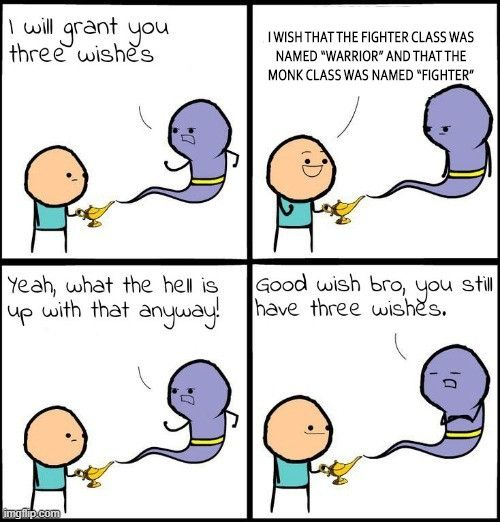
2). Fold the Monk class back into Cleric somehow to distinguish the class from Paladin. I would love to see more hooded silent monks busting out nunchucks and quarterstaves. Father Fujimoto of Blue Exorcist is one of my favorite anime characters. This would also make Clerics unique in their access to unarmed combat, separating them from the Martial weapon-wielding Paladins.
3). Alternatively, you could fold the Monk class into Paladin. An Oath of the Ascetic could get the huge boost to unarmed combat, and the Paladin’s spells can reflect the wide range of supernatural ki techniques.
4). Give more classes options for basic unarmed combat, removing the Orientalist suggestion that “only Monks know kung fu” in the same way Benjamin Huffman’s Pugilist class does. Plus, each class could address unarmed combat in ways that served their respective mechanics, further dismantling the monolithic notion that all martial arts are the same.
To explore one of these fixes, I’ve written here a Paladin Oath of the Ascetic.
Oath of the Ascetic
Tenets of the Ascetic
Harm No Living Thing – Avoid deadly violence whenever possible
Lust Not for the Material – Avoid temptation of wealth and worldly rewards
Pursue Self-Enlightenment – Always strive to surpass your own limits
Level 3: Oath of the Ascetic Spells
The magic of your oath ensures you always have certain spells ready; when you reach a Paladin level specified in the Oath of the Ascetic Spells table, you thereafter always have the listed spells prepared.
Oath of the Ascetic Spells
Paladin Level | Spells
3 | Feather Fall, Shield
5 | Mirror Image, Gust of Wind
9 | Dispel Magic, Water Walk
13 | Freedom of Movement, Stoneskin
17 | Awaken, Commune With Nature
Level 3: Martial Arts
When you take this oath at level 3, you gain mastery of combat styles that use your Unarmed Strike.
You gain the following benefits.
Reactive Strike. When you are missed by a Melee attack, you can make an Unarmed Strike as a Reaction.
Martial Arts Die. You can roll 1d8 in place of the normal damage of your Unarmed Strike.
Dextrous Attacks. You can use your Dexterity modifier instead of your Strength modifier for the attack and damage rolls of your Unarmed Strikes. In addition, when you use the Grapple or Shove option of your Unarmed Strike, you can use your Dexterity modifier instead of your Strength modifier to determine the save DC.
Level 3: Channel Divinity
You gain the following two Channel Divinity options.
- Step of the Wind. You can take the Disengage or Dash action as a bonus action on your turn, and your jump distance is doubled for the turn.
Bodhisattva’s Palm. As a Magic action, you can expend one use of your Channel Divinity to loose a wave of destructive energy from your palm. Each creature in a 25-foot Cone originating from you makes a Constitution saving throw. On a failed save, a creature takes 2d8 Thunder damage and is pushed 10 feet away from you. On a successful save, a creature takes half as much damage only.
Level 7: Aura of Awareness
You and your allies have Blindsight with a range of 10 feet while in your Aura of Protection.
At 18th level, the range increases to 30 feet.
Level 15: Resilient Meditation
As a Magic action, you can expend one use of your Channel Divinity to enter a trance. While in the trance, you have the Incapacitated condition and are immune to all damage sources. You may end the trance at the start of your turn(no action required). If you remain in the trance for one minute, the trance ends, and you gain the benefits of a Short Rest.
Once you use this feature, you cannot use it again until you complete a Long Rest.
Level 20: Thousand Lives’ Counsel
You can use a Bonus Action to expend a use of your Channel Divinity and call upon the collective experiences of your past lives. For one minute, you gain Advantage and add your proficiency bonus to all D20 Tests.
Once you use this feature, you cannot use it again until you complete a Long Rest.
Ready for More?
If you love what we make at TBM Games, back us on Patreon! Adventurer Tier Patrons and up receive a PDF copy of each article’s game content, and your support ensures we continue writing TTRPGs you love, as well as giving you early access to our blog articles.
BIBLIOGRAPHY:
Tresca, Michael J. (2014). The Evolution of Fantasy Role-Playing Games. Jefferson, N.C.: McFarland & Co. ISBN 978-0-7864-6009-0. OCLC 697175248
“Doug” (2021). Monks, Monks and Monks: yes, there is a difference. WordPress.com.
Yang, Jwing-Ming (1999-06-25). Ancient Chinese Weapons, Second Edition: The Martial Arts Guide. YMAA Publication Center. ISBN 1-886969-67-1.
Discover more from TBM Games
Subscribe to get the latest posts sent to your email.